
Travel Insurance Compare: Key Benefits & What to Look For in 2025
Guide — 2025
Travel Insurance Compare: Key Benefits & What to Look For in 2025
Learn how to compare travel insurance plans quickly and confidently: what coverage matters most (medical, repatriation, baggage, delay, accidental death), which plan options suit students, families, or long-stay nomads, and an easy checklist to pick the right policy in 2025.
Why Compare Travel Insurance in 2025?
Travel insurance has evolved: AI pricing, nomad-specific policies, wider pandemic-related protections, and faster claim handling. Comparing plans prevents overlap, saves money, and ensures you’re covered for the risks that matter to your trip.
- Real costs: Medical evacuations and hospital bills abroad can exceed tens of thousands — compare limits and excess (deductibles).
- Plan fit: Single-trip, multi-trip, student, or long-term nomad plans differ — pick by travel pattern.
- Exclusions: Adventure activities, pre-existing conditions, and high-risk countries require specific add-ons.
Core Benefits to Compare (At-a-glance)
Focus first on coverage limits and real-world value, not just catchy plan names.
| Benefit | Why it matters | What to look for |
|---|---|---|
| Medical expenses | Highest potential cost — emergency care, hospital stays, surgery. | Limit ≥ $50,000 for global travel; higher for long-stay or US-bound trips. Check excess and emergency assistance network. |
| Medical evacuation / repatriation | Air ambulance or repatriation costs skyrocket without cover. | “Actual expenses” wording or a high fixed limit; repatriation to home country included. |
| Accidental death & disability | Immediate financial protection for family after fatal accidents. | Clear amounts per plan tier, and what modes of transport are covered (plane, train, taxi). |
| Baggage & personal items | Replaces essential items after loss or theft. | Separate sub-limits for electronics, documents; fast claims for essentials on arrival. |
| Trip cancellation & interruption | Recovers prepaid non-refundable costs if you must cancel for covered reasons. | Covered reasons list (illness, jury duty, travel advisory) and documentation requirements. |
| Delay & missed connection | Covers meals, hotels, and rebooking costs during long delays. | Minimum delay window (e.g., 6+ hours) and daily caps — check elevator clauses. |
Note: policy wording varies — “up to” limits matter less than exclusions and claim process speed.
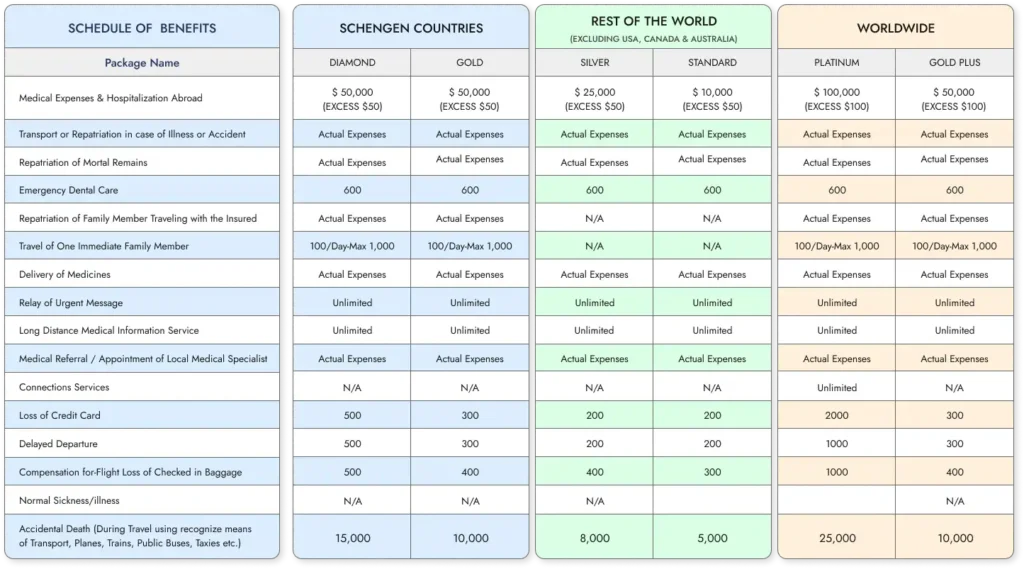
How a Typical Provider (Example: United Insurance) Structures Benefits
This example shows common plan tiers and realistic benefit ranges. Use it as a baseline when comparing providers.
- Platinum / Worldwide: High medical limits (e.g., $100,000), evacuation, higher baggage and delay cover, family repatriation.
- Gold / Schengen: Schengen-compliant medical limits (commonly $50,000) for EU/Schengen travel.
- Silver / Standard: Lower medical limits (~$10k–25k) for budget trips or regional travel.
Examples of practical features to confirm with the insurer: delivery of medicines, medical referral services, in-app claims, 24/7 emergency hotline, and ability to add family members or students easily.
Quick Checklist: What to Verify Before You Buy
- Medical limit & excess amount (deductible) — run the worst-case math.
- Evacuation/repatriation wording — “actual expenses” is best.
- Pre-existing medical condition rules — look for waivers or exclusions.
- Adventure sports/excursions — add coverage if you’ll ski, dive, or trek.
- Claims process & local partner network — 24/7 assistance and local hospitals are a big plus.
- Policy territory — Schengen, Worldwide Excluding USA, Worldwide including USA — choose according to travel plan.
- Refund/cancel window — free cancellation or short cooling-off period.
Which Plan Type Fits Your Travel Style?
Match your trip to the right product to avoid overpaying or underinsuring.
- Short vacation / single trip: Single-trip plan with good medical and baggage limits.
- Frequent flyers / business: Annual multi-trip policy with per-trip limits and fast claims.
- Students / study abroad: Student plans with medical & repatriation plus coverage for study-related supplies.
- Digital nomads / long-stay: Long-stay or nomad-specific policies — watch out for residency conditions and continuous coverage rules.
Pricing — How to Understand Cost vs Value
Price is important but don’t let low premium be the deciding factor. A slightly higher premium often buys a dramatically better payout limit or smoother claims process.
Tips:
- Compare the excess: a low premium plus very high excess may not save you money in a real emergency.
- Look for bundled benefits (e.g., baggage + delay + assistance) that reduce the friction during a claim.
- Use comparison tools and read recent user reviews about claim turnaround time.
Claims: The Part People Forget to Compare
Fast, transparent claims are worth paying for. Check:
- Availability of 24/7 emergency hotline and multilingual support.
- Online claim submission and average payout time (user reviews are useful).
- Document requirements — some providers ask for police or official reports for theft claims; others are more flexible.
Frequently Asked Questions
Is travel insurance necessary for international trips?
Yes, travel insurance is essential when traveling abroad as it covers unexpected medical costs, trip cancellations, and lost belongings.
Does travel insurance cover pre-existing conditions?
It depends on your plan. Some providers offer coverage for pre-existing conditions if purchased within a specified time frame after booking.
Can I buy travel insurance after booking my trip?
Yes, you can, but buying it early provides better coverage, including trip cancellation benefits before departure.
What factors affect travel insurance cost?
Age, destination, trip duration, and coverage limits all influence the total cost of travel insurance.
Post a Comment for "Travel Insurance Compare: Key Benefits & What to Look For in 2025"